Showing posts with label sustainability. Show all posts

Education: Factory Safety - What can we do?

We don't think about how our clothes are made. We see a t-shirt at a store, we probably check the price - and if we like it, we buy it. Rarely do we stop and think about where that t-shirt was made, or what materials were used or under what conditions it was produced. 

Rana Plaza building collapse in Savar, Bangladesh - Image via Wikipedia

Then suddenly terrifying pictures of young seamstresses jumping out of burning factory windows in Pakistan and rescue services pulling dead bodies out of the ruins of a collapsed factory building in Bangladesh pollute our news and we are shocked. We think 'that must be terrible for the families!' and 'what if that happened here?' - but we don't realize: These people died stitching the hem on the exact t-shirts we were going to buy a couple of months later. Even though we all know that most of our garment production takes places in South East Asia, Bangladesh and Pakistan are just too far away to fully grasp the impact of such devastating incidents. When we do get the occasional sting of guilt, we justify our lack of initiative with the deterministic question: 'But what can we - as simple consumers - really do?'

About 100 years ago, when such a disaster happened right in our midst, we knew what to do: Looking back on the fire in the Triangle Shirtwaist Factory in 1911 right here in Manhattan puts a whole new perspective on the fashion industry's marvelous idea of outsourcing (or: off-shoring) all the time-consuming sewing work to foreign countries marked by devastating poverty and desperate people living below the breadline - foreign countries that are also conveniently far, far away. With the ignorant motto of 'out of sight, out of mind' the fashion industry has managed to put the consumer's mind at ease  - and reduce the garments' prices all at the same time. Seems like a win-win situation.

If I learned one thing from today's conference 'Factory Safety - What can we do?' at the Fashion Institute of Technology in NYC, it is that this current situation is not a win-win situation. Among corporate social responsibility (CSR), sustainability and eco-friendliness, the conference focused on the comparison of today's incidents in South East Asia with the disaster of 1911 in New York - and what we can do to help. It was also possible to design and create one's own shirtwaist banner that would be carried at the Triangle Shirtwaist Factory fire memorial ceremony on March 25.
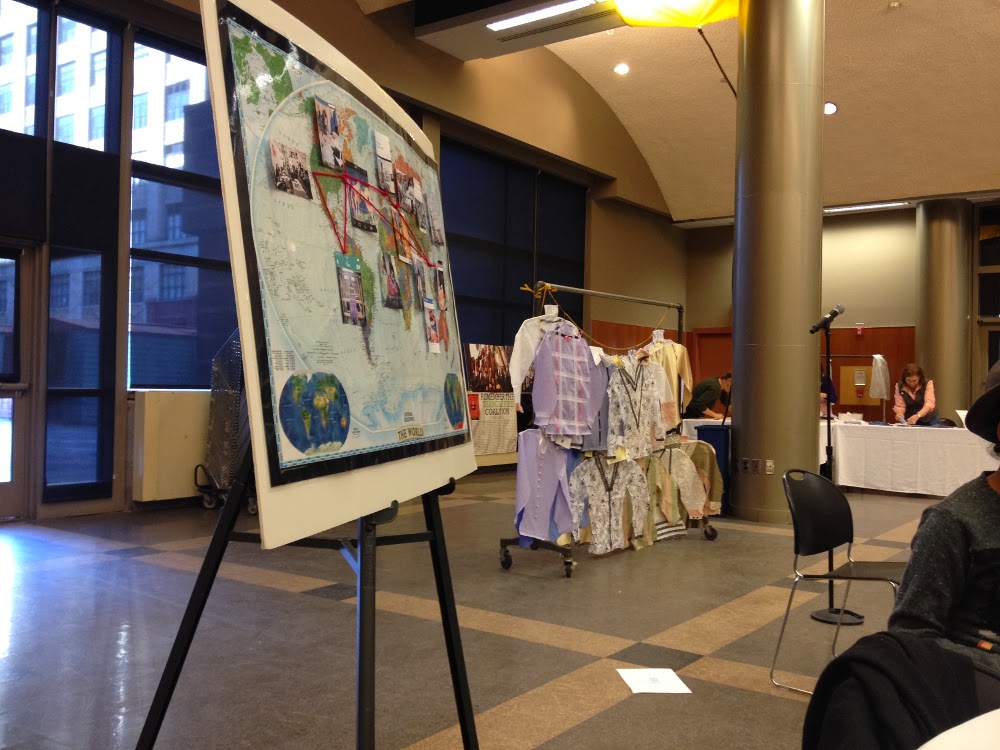
Shirtwaist banners designed and created by conference participants

The participants were able to discover both the corporate side of CSR with guest speaker Marissa Pagnani who represented PVH and also the academic side with a panel of FIT faculty and students who founded the university's own CSR Club (that I joined!). All throughout the conference, participants were encouraged to voice their opinions and join the discussion, which communicated very nicely that all of us are in this together. Last but not least, Charles Kernaghan, the Director of the Institute for Global Labour and Human Rights, talked about his work.

Kernaghan started off by telling us about the fire in the Triangle Shirtwaist Factory that caused young - mostly immigrant - seamstresses to jump from the 8th, 9th and 10th stories of the Asch building on the northwest corner of Greene Street and Washington Place in Manhattan - because the emergency exits were locked - in order to not be fully consumed by the deadly flames and to ensure that their families would be able to identify them after their death. Does this sound familiar to you? 

The Triangle Shirtwaist Factory after the fire in 1911 - Image via Public History Blog

Back then, the fire took the lives of 146 garment workers - 123 female, 23 male - and set the stone for a political movement towards safety standards. Unions were organized, specifically the International Ladies' Garment Workers' Union, that helped improve unfair working conditions for garment workers.  By 1938, sweatshops were virtually eliminated in the US until the 1980s when the fashion industry began to outsource its production to South East Asia, which, so Kernaghan, ruined all the progress made in previous years.

The accident of the collapsed Rana Plaza building in Savar, Bangladesh, on April 24, 2013, took 1,129 lives and was only the latest of a serious of deadly accidents in factories in South East Asia - but still barely any changes have been made so far. Even though the companies that produced at these factories are trying to improve working conditions in collaboration with the Accord - by auditing and monitoring the factories to make sure that no emergency exits are being locked and that enough fire extinguishers are available, for example - there is still more to be done. The Bangladeshi government still doesn't grant its people the right to organize, which gives them no form of representation and no way of standing up against the factory owners and supervisors in face of unfair working conditions. Before the implementation of a minimum wage, the workers at the Triangle Shirtwaist Factory earned $3.18/hour (for today's standards), while the workers in Bangladesh today earn only $0.28/hour. 

Charles Kernaghan - Director of the Institute of Global Labor and Human Rights

In 2009, the American Congress passed a law - the Dog and Cat Protection Act - that prohibits the import of dog and cat fur from China into the US - but we can't protect humans with a similar law? Businesses owners are allowed to protect clothing labels by law but not the workers who produce the garments because that would be 'an impediment to free trade?' Why are we supporting these businesses, such as Walmart, Sears and the Gap, that exploit garment workers for cheaper prices and higher margins? Is a low price really all that matters to us? Are Bangladesh and South East Asia really that far away that we can't empathize with and support the struggling people there?

These are all questions that can't be easily answered but the unified message of all speakers seemed to be that the progress of this movement is, indeed, up to us. We need to inform and educate ourselves about the companies we buy from, about their production processes and their CSR programs. We need to make educated buying decisions taking these factors into account and use our buying power for the good. The change won't happen over night but if we all participate, we can make a difference. 


Education: But what is Sustainable Fashion?


Sure, it is great being able to buy a piece of clothing for less than $10 (Primark, I'm looking at you!) and we have certainly all done it. But didn't you also feel that little sting of guilt when you were waiting in line and wondering how that blouse was actually made? 

Unfortunately, it is still very easy for consumers to claim that they simply didn't know better. Even though companies are being more and more open about where and how their garments are made, it is still a very grey area. We want to start giving you more knowledge and understanding of the topic in order to inspire you to become more conscious of your own clothes and shopping habits.

So, let's get started! But what even is sustainable fashion?

According to the American Environmental Protection Agency (EPA), sustainability "creates and maintains the conditions under which humans and nature can exist in productive harmony, that permit fulfilling the social, economic and other requirements of present and future generations." 

But what does that mean for fashion?

In terms of fashion, the definition is a little more complex. Sustainable fashion means that a garment is produced in consideration of its environmental and social impact all throughout its lifespan. As you may see, it is very hard to find a universal definition that everyone can use as a reference. 

Especially, in today's economy it is hard to implement sustainable changes and still maintain profitable. Sandy Black, expert on sustainable fashion and professor at London College of Fashion, knows the complexity of the topic: "The big definition is about long-term sustainability, but also there's the economic sustainability, then there's ethical and social issues. So in a way, the best type of businesses have combined all sorts."

And that's what most clothing companies have been trying to do: Finding a balance between the sustainable, ethical, social and the economic requirements. In the next weeks, we will look at some companies that are doing a pretty good job at being more sustainable.


Industry Trend: Fast Fashion Becomes Sustainable


As soon as the models leave the glamorous runways of the international fashion capitals and the designers retreat to celebrating their success, big textile companies all over the world start to get to work: According to an article by Suzy Hansen in The New York Times, big clothing corporations like Inditex require about two weeks to take inspiration from the upcoming season’s fashion shows and create their own, more affordable version of a ready-to-wear garment. Inditex makes 840 million garments a year in this fashion and delivers them to their stores, including Zara and Massimo Dutti, almost twice a week, striving to keep the stock fresh. Customers seem to adjust to the speed of fast fashion: Inditex has little to no leftover stock in their stores before the next order of must-have pieces arrives.

Pictures via Google

Fast fashion not only affects the customer’s shopping behavior, it also has a big impact on the environment. Statistics published by the U.S. Environmental Protection Agency (EPA) show that the average t-shirt wastes about 700 gallons of water during manufacturing, the amount that could fill 140 water cooler jugs. For every pound of textile being produced, 7 pounds of CO2 is being emitted. The textile manufacturers are not the only ones to blame: The new trend of fast fashion leads to 13.1 million tons of textiles being trashed each year, the average American accounting for nearly 65 lbs. Forty-eight percent of Americans throw away reusable textiles instead of recycling them. But even though there is still a long way to go, fashion companies have already identified their negative environmental impact and made changes in their business models.


In 2011, big companies throughout all industries were hesitant in making costly sustainable changes in fear for becoming unprofitable. Now they are becoming more confident with implementing sustainability programs.  According to the fourth annual study released last February by the MIT Sloan Management Review (MIT SMR) and the Boston Consulting Group (BCG), “The Innovation Bottom Line”, nearly half of the surveyed 2,600 executives and managers from companies around the world changed their business models as a result of sustainability opportunities since 2012, which marks a 20 percent rise from the previous year. 


The percentage of companies reporting a profit from these sustainability changes, coined as “Sustainability-driven innovators” by executive editor at MIT SMR and co-author of the report, David Kiron, rose from 14 percent in 2012 to 37 percent in 2013. "Sustainability-Driven Innovators see the opportunity differently than do companies that haven't gleaned sustainability's financial rewards," says Kiron. "They don't dwell on it as a cost issue. They focus on how their efforts can increase market share, boost energy efficiency, and build competitive advantage."


The heightened awareness of sustainability and ethics in customers and their more critical view of the companies’ production standards, as well as the working conditions also forced big textile corporations to start making alterations. But what exactly does it mean for a company to be sustainable? According to Toby Heaps, editor-in-chief of Corporate Knights, sustainability means “creating more wealth than we destroy. It means that a company is on balance increasing our overall stock of wealth, grounded in human, produced, financial, natural, and social capital.” 


Every year the magazine releases the Global 100, a list of the most sustainable companies in the world. In the most recent ranking in 2013, Inditex received rank 26, showing that fast fashion might not stand in the way of sustainability after all. According to a press release from the company, Inditex conducted about 1.5 million tests on its clothing in 2012 to ensure health and safety standards and carried out more than 3,500 audits on suppliers under its own Code of Conduct. Furthermore, the company commit to producing zero discharge, to optimize the water management and to assist their suppliers in adopting more sustainable industrial processes.


Even though fast fashion companies like Inditex are starting to implement sustainable changes, there are still more sustainable opportunities to take. Industry experts still wonder if fast fashion companies are able to diminish the negative environmental impact and the bad working conditions – and stay profitable at the same time. Alex McIntosh, the business and research manager at the London College of Fashion’s Sustainable Fashion, questions if the fast fashion business model is able to last. “Eventually, there aren’t going to be resources to sustain fast fashion. Production costs will also get more expensive, and they won’t be able to keep this up. Value-based companies don’t have margins to absorb that additional cost. And then they will need to convince customers to spend more for clothes again.”


Designer to Watch: Rosemary Paone Designs


Now that the fashion week craziness is over, we can finally show you the pictures of our little photo shoot and introduce to you the lovely and talented Rosemary Paone! I know, I know, we have been flooding your social media with this, but, you know, one day in the near future you will appreciate our nagging - because you will have known Rosemary Paone before she was world-famous!

Rosemary Paone is a New York City-based young fashion designer who goes the Fashion Institute of Technology with Kim. Two of her favorite designers, Marchesa and McQueen, are known for their breath-taking gowns. Coincidence? I think not. Inspired by nature and classic silhouettes, she creates feminine clothing that make a woman look - and feel - beautiful.
Rosemary Paone won 2nd place in a national competition called Fashion Island, where she submitted the 'Zoo Dress' inspired by tortoises and the Staten Island Zoo. She also made a dress for Miss Verrazano to wear during her campaign to be Miss New York, bringing her huge regional popularity. For the famous twig dress she won 1st place in her High School's Green Fashion Show - two times in a row! Just recently, her twig dress has been put on display in a very cool clothing store in SoHo, that specializes in sustainable clothing made from eco-friendly fabrics. 

You think it can't get any better than this? Well, the greatest of Rosemary's achievements is being a lovely person - and an amazing friend to all of us. Kind-hearted and honest, she accomplishes everything she does with passion. And that - without a doubt - shows in her designs. But see for yourself ...


If you want to know more about Rosemary Paone Designs, go visit her websites:


Like it, share it, bookmark it!